
I’m super excited that this prize is back for a second year – and long may it continue! Climate Fiction is such an interesting and emerging genre of late, though, of course, there are authors who have been using the climate crisis in their works for a while already!
Last year, I read the shortlisted books, but this year I am planning to read the entire longlist.
So, what is the Climate Fiction Prize?
The Climate Fiction Prize is a new literary prize to highlight new novels that speak about the climate crisis in some way. The people behind the prize feel (and I agree!) that stories are one of the best ways to understand issues that we face as a people, and that climate fiction can help people more easily imagine an uncertain future, but also help us respond to it too.
They define climate fiction as:
At its heart, climate fiction can be thought of as stories that engage, in some way, with the climate crisis and our response to it. Whether that be grand, sweeping narratives portraying societal responses to a shifting world climate, or an intimate portrait of one character’s response to their local environment, any story in which our changing global climate is an inciting element is climate fiction.
Climate fiction is not a genre in and of itself but rather a lens through which to view literature – how is the preeminent challenge of our times reflected in the fiction being written today? How does fiction allow us to explore our individual and collective response to the crisis? And what impact can climate fiction have?
the 2026 Prize & my plans
The longlist for the prize was announced in February, and there are 12 books on the list this year. The shortlist was announced in mid-March and contains 6 of those books. As of now (4th April) I have read 3 of the shortlisted books and 6 overall.
My plan is to have the longlist read by the time the winner is announced, so I need to read 3 of them this month! I haven’t started reviewing any at the time of writing this, but I shall come back and link to future reviews in this post when I do so.
Without further ado, onto the books!
The 2026 Books
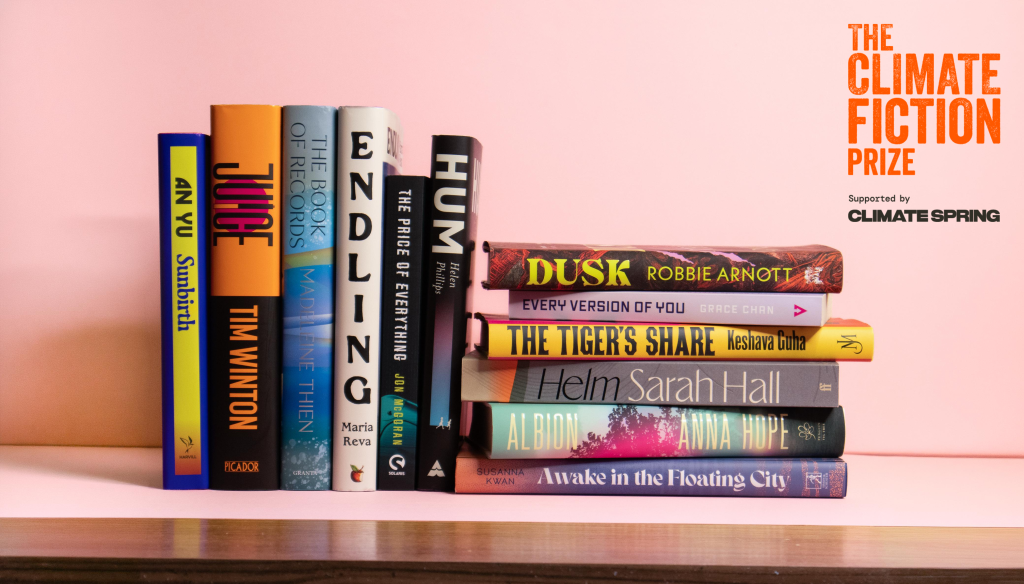
Longlisted:

In Five Poems Lake, a small village surrounded by impenetrable deserts, the sun is slowly disappearing overhead. A young woman keeps one apprehensive eye on the sky above as she tends the pharmacy of traditional medicine that belonged to her great grandfather…
When the Beacons begin to appear—ordinary people with heads replaced by searing, blinding light, like miniature suns—the town’s residents wonder if they may hold the answer to their salvation, or if they are just another sign of impending ruin.
Two fugitives, a man and a child, drive all night across a stony desert. As dawn breaks, they roll into an abandoned mine site. From the vehicle they survey a forsaken place – middens of twisted iron, rusty wire, piles of sun-baked trash.
They’re exhausted, traumatised, desperate now. But as a refuge, this is the most promising place they’ve seen. The child peers at the field of desolation. The man thinks to himself, this could work.
Problem is, they’re not alone.

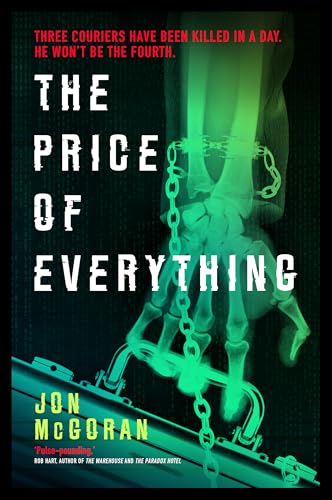
When Armand Pierce first became a courier ten years ago, he had an attaché case connected to a titanium cuff grafted into the bones of his wrist, and took an oath: the delivery is everything.
He can run, fight—kill, if he needs to—but the package gets where it’s going. It’s the Guild’s guarantee, and since the internet went down in the Cyber Wars, all business, legitimate or otherwise, depends on it.
Otherwise, he dies.
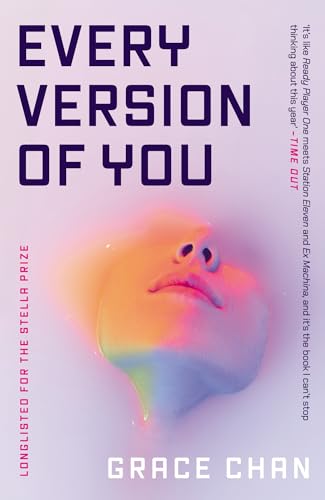
In late twenty-first century Australia, Tao-Yi and her partner Navin spend most of their time inside a hyper-immersive, hyper-consumerist virtual reality called Gaia. They log on, go to work, socialise, and even eat in this digital utopia. Meanwhile their aging bodies lie suspended in pods inside cramped apartments. Across the city, in the abandoned ‘real’ world, Tao-Yi’s mother remains stubbornly offline, preferring instead to indulge in memories of her life in Malaysia.
When a new technology is developed to permanently upload a human brain to Gaia, Tao-Yi must decide what is most important: a digital future, or an authentic past.

Helm is a ferocious, mischievous wind – a subject of folklore and awe, who has blasted the sublime landscape of the Eden Valley since the very dawn of time.
Through the stories of those who’ve obsessed over this phenomenon, Helm’s extraordinary history is formed: the Neolithic tribe who tried to placate Helm, the Dark Age wizard priest who wanted to banish Helm, the Victorian steam engineer who attempted to capture Helm – and the farmer’s daughter who loved Helm.
But now Dr Selima Sutar, surrounded by infinite clouds and measuring instruments in her observation hut, fears human pollution is killing Helm.
The Brooke family are gathering in their eighteenth-century ancestral home to bury Philip: husband, father and the blinding sun around which they have all orbited for as long as they can remember.
With the family split over the future of the estate – dreams of rewilding and a last line of defence against the coming climate catastrophe or a treetop haven for the super-rich – the arrival of Clara, shrouded in secrets, brings with her a truth that will fracture all the dreams on which they’ve built their lives.

Shortlisted:
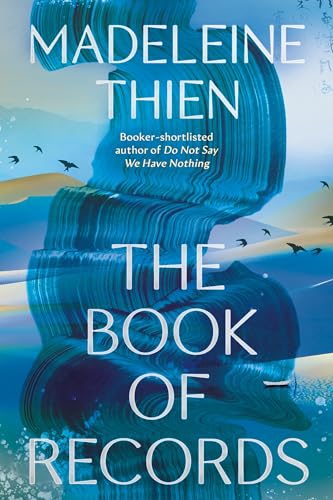
Lina and her father have arrived at an enclave called The Sea, a staging-post between migrations, with only a few possessions. In this mysterious and shape-shifting place, a building made of time, pasts and futures collide.
Lina befriends her neighbors: Bento, a Jewish scholar in seventeenth-century Amsterdam; Blucher, a philosopher in 1930s Germany fleeing Nazi persecution; and Jupiter, a poet of Tang Dynasty China. Under the tutelage of these great thinkers, Lina equips herself to face her ailing father’s troubling admissions about his role in their family’s tragic past.
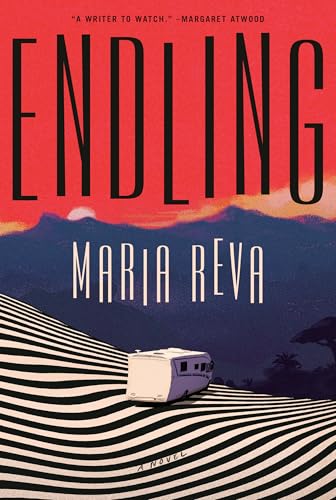
Ukraine, 2022. Yeva is a loner and a maverick biologist who lives out of her mobile lab. She scours the country’s forests and valleys, trying and failing to breed rare snails while her relatives urge her to give up, settle down, and start a family. What they don’t know: Yeva already dates plenty of men—not for love, but to fund her work—entertaining Westerners who come to Ukraine on guided romance tours…
Nastia and her sister Solomiya are also entangled in the booming marriage industry, posing as a hopeful bride and her translator while secretly searching for their missing mother—a flamboyant protestor who vanished after years of fierce activism against the romance tours.
So begins a journey of a lifetime across hundreds of miles…
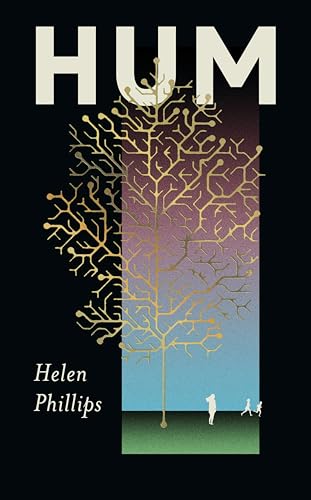
In a city addled by climate change and populated by intelligent robots called “hums,” May loses her job to artificial intelligence. In a desperate bid to resolve her family’s debt and secure their future for another few months, she becomes a guinea pig in an experiment that alters her face so it cannot be recognized by surveillance.
Seeking some reprieve from her recent hardships and from her family’s addiction to their devices, she splurges on passes that allow them three nights’ respite inside the Botanical Garden: a rare green refuge where forests, streams, and animals flourish. But her insistence that her son, daughter, and husband leave their devices at home proves far more fraught than she anticipated, and the lush beauty of the Botanical Garden is not the balm she hoped it would be. When her children come under threat, May is forced to put her trust in a hum of uncertain motives as she works to restore the life of her family.
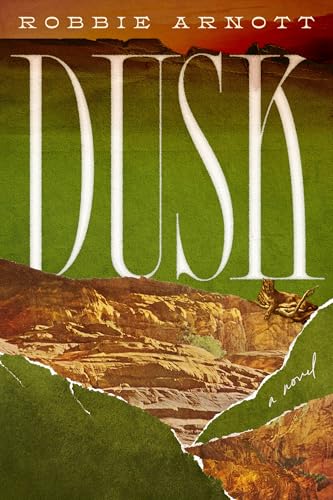
In the distant highlands, a puma named Dusk is killing shepherds. Down in the lowlands, twins Iris and Floyd are out of work, money and friends. When they hear that a bounty has been placed on Dusk, they reluctantly decide to join the hunt.
As they journey up into this wild, haunted country, they discover there’s far more to the land and people of the highlands than they imagined. And as they close in on their prey, they’re forced to reckon with conflicts both ancient and deeply personal.

The fiercest wars are fought between siblings.
Tara, a successful Dehli lawyer, is everything her younger brother isn’t: dedicated, independent, thriving. When their beloved father retires, he summons them to a meeting. But what he has to say threatens to tear the family apart.
Tara’s friend Lila has it all: a great job, a lovely home, a beautiful family. But when Lila’s father dies unexpectedly, her brother wastes no time in claiming what he thinks is his.
Together, Tara and Lila are forced to confront the challenge that their ambition poses to patriarchal Delhi society.
In a future San Francisco transformed by years of rain, Bo, a 40-year-old lapsed artist, is grieving the community she’s lost to catastrophic flooding. Her friends and family have disappeared or fled, the streets are rivers, and the buildings are falling apart.
Yet on the day of her planned departure, Bo finds a note slipped under her door: I need help, it reads. Three days a week, afternoons. Can pay in cash.
Unable to bring herself to board the ship that could save her life, Bo instead chooses to answer the note, which turns out to have been written by her neighbour Mia, a 130-year-old “supercentenarian” long abandoned by her own family.


 Pages of Emma
Leave a reply to Emma Cancel reply