
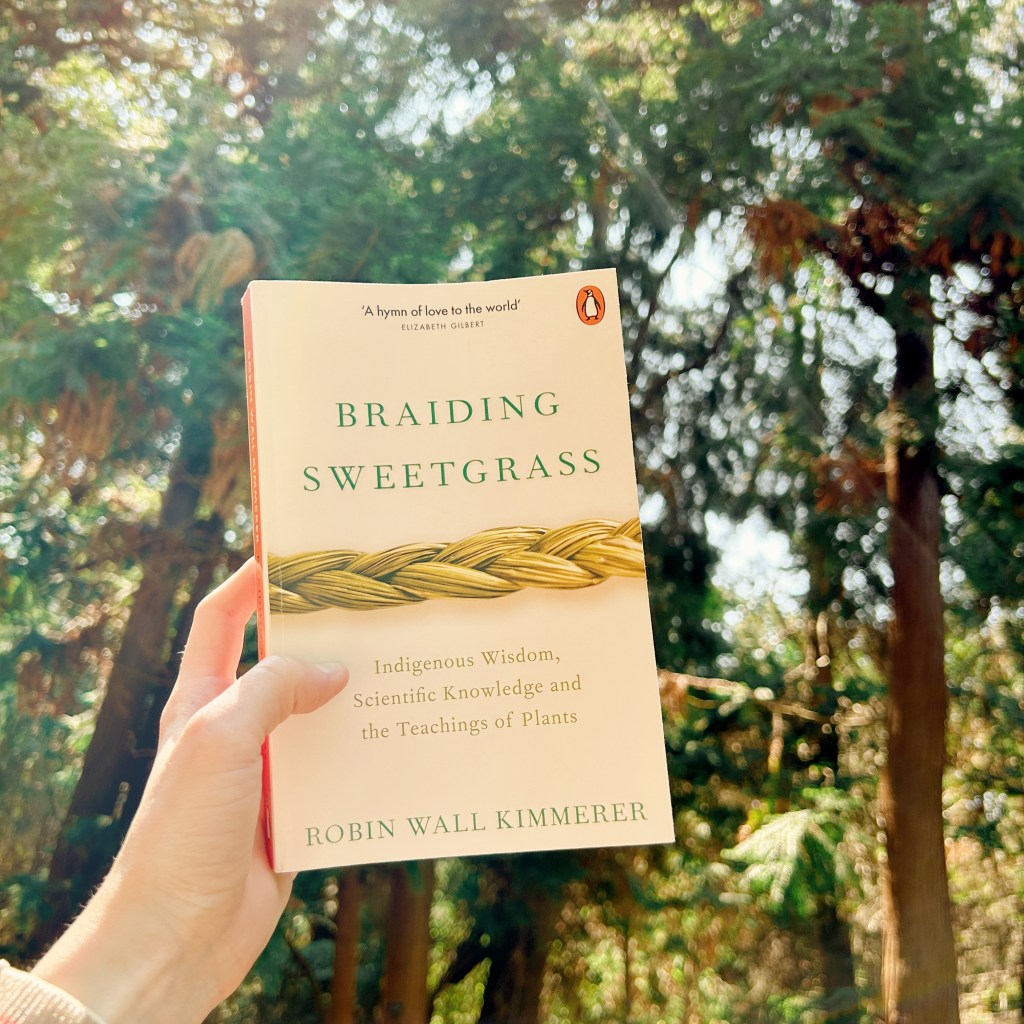
I thought it was about time that non-fiction books made it over to the blog. After all, it is my second most-read genre after sff books. And what better book to start with than my favourite of all time?
Synopsis:
As a botanist, Robin Wall Kimmerer has been trained to ask questions of nature with the tools of science. As a member of the Citizen Potawatomi Nation, she embraces the notion that plants and animals are our oldest teachers. In Braiding Sweetgrass, Kimmerer brings these lenses of knowledge together to show that the awakening of a wider ecological consciousness requires the acknowledgment and celebration of our reciprocal relationship with the rest of the living world. For only when we can hear the languages of other beings are we capable of understanding the generosity of the earth, and learning to give our own gifts in return.
Review:
It has taken me so many years to finally write something about this beautiful book. I’ve read it at least 5 times cover to cover now, and I am sure I will read it many more times again. It is perhaps the book I would use as an answer to the question “What is your favourite book?”, but it is difficult for me to articulate exactly why. Braiding Sweetgrass is not just a book I like to read. It changed the way I think about things, about the natural world and our place as humans in it.
The very first thing we come to learn in this book is that Indigenous people see the land as sacred ground, as connection to ancestors, as a teacher, a healer… as a home to their animal-kin. This is such a stark contrast to everything we usually see about the land. I recall reading a tweet asking how a forest can contribute to a country’s economy (after I had already read Sweetgrass), and I was upset that in this modern age that everything is seen as a commodity, and that the true value of our land (medicine, carbon capture, wellbeing, etc) is just not realised or seen as important.
This book will teach you the true value of nature. It will teach you the art of reciprocity, that what we receive from the land is a gift, not a right, and that you should give back to the land in return. It will teach you how to Naturalise yourself, to learn to listen to the land and all the living beings that live on it. It will teach you that you are an equal in all of nature, that everything – not just humans – deserves respect.
Aside from the important messages in this book, the way Kimmerer writes is just wonderful. She interweaves science and stories, with prose that is almost lyrical. Her love for the land is so potent in her words. Every time I read this book, I read it slowly, one chapter at a time so I can let the words sink into my soul.
This is perhaps, less a review and more a plea. Read this book. Let it teach you. Let it open your eyes.


 Pages of Emma
Leave a comment